Once upon a time, modular construction and modular housing were regarded as temporary "prefab huts" or niche technical pilots, and permanent modular construction was even unrecognized by the public. However, amid ongoing labor shortages, intensifying housing crises, and global cities' dual pursuit of efficiency and fairness, this "factory-built housing" revolution has quietly crossed the critical threshold. Centered on factory-built housing, the modular construction model is no longer just an option in the construction industry; it is becoming a "must-solve problem" and a "game-changer" that reshapes urban housing supply, employment and industrial logic, with commercial modular buildings simultaneously expanding their application boundaries.
Data from the global market provides the most straightforward answer. According to Astute Analytica, the global modular construction market reached $90.3 billion in 2024, and is projected to exceed $155.2 billion by 2033, with a steady compound annual growth rate of 6.2%. Among segments, modular housing holds an absolutely dominant position, accounting for more than 53% of the market share, and permanent modular construction has become the mainstream, completely shedding the label of temporary buildings.
This growth is no accident. Against the dilemma of traditional construction models — the U.S. construction industry faces a labor shortage of 500,000 workers, and the UK will still need to fill 250,000 construction jobs by 2028 — modular construction delivers a dimensionality-reducing impact on traditional models through its industrialized logic. Assembly lines and robotic automation in factories drastically reduce labor dependence and errors, while digital twin technology optimizes production processes, fully demonstrating the standardized and large-scale advantages of factory-built housing. The Hinkley Point C Nuclear Power Station project cut rebar installation time by 75% through modular methods, and Canadian school districts quickly expanded classroom capacity with modular buildings. These cases collectively prove that modular construction resolves the industry's dilemma of "speed, quality and cost", enabling efficient implementation for both civilian modular housing and commercial commercial modular buildings.
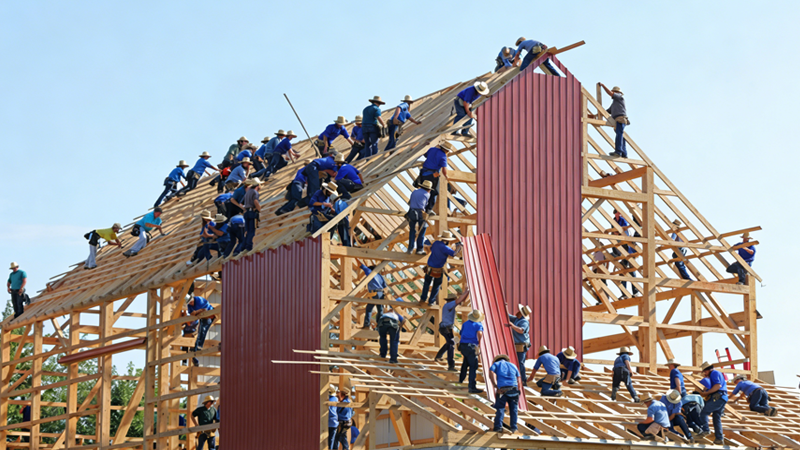
Construction site of light wood frame modular houses
The true value of modular housing lies not only in construction efficiency, but also in its response to two fundamental livelihood issues: how to make housing affordable for ordinary people, and how to let workers earn a living with dignity.
First, it is an industrialized solution to the housing crisis. Facing more than 770,000 homeless people across the U.S., and the predicament of traditional affordable housing with a unit cost of up to $650,000 and years-long construction cycles, modular housing demonstrates remarkable social relief value. The cost of a single transitional modular unit can be as low as $50,000, with construction time shortened from years to weeks. It can quickly build micro-communities to house the homeless, and can also be upgraded to permanent modular construction to become high-quality affordable housing. Philadelphia's practice is highly representative: through the "Housing Manufacturing Hub" initiative, $50 million in union pension funds was leveraged to renovate old apartments, providing 336 affordable housing units for the elderly, and integrating the project into a $20 billion housing plan aimed at creating and preserving 30,000 housing units. This marks a shift in urban housing policy from "passively filling gaps" to "actively expanding supply", with factory-built housing becoming a core tool for ensuring people's livelihoods.
Second, it has gained consensus among workers, achieving a steady upgrade of employment models. The most compelling proof of modular construction's value is the reversal of attitude from construction unions, which once feared job losses. Two major core unions in California explicitly support factory-built housing, arguing that it does not eliminate on-site construction jobs but creates more stable factory positions. Workers bid farewell to the instability of frequent job site transfers, gaining regular working hours, steady incomes and the ability to balance work and family, achieving a smooth transition from "construction employment" to "manufacturing employment". This two-way achievement of "housing supply + employment" frees modular housing and permanent modular construction from the attribute of a mere technical tool, turning them into a warm social governance solution.
Currently, modular housing is enjoying a superposition of four dividends: policy, technology, market and public consensus, with the development environment for factory-built housing and commercial modular buildings continuously improving.
At the policy level, from Philadelphia enshrining the "Housing Manufacturing Hub" in its urban agenda, to California lawmakers reaching consensus with unions, and federal funding flowing through channels such as the $6 billion Housing Infrastructure Fund, governments are clearing obstacles for modular development through top-level design. At the technical level, the popularization of steel structures, automation and digital twins has made modular construction fully meet the seismic, fire safety and environmental standards for permanent residences, with the quality ofpermanent modular construction certified by authorities, completely breaking the public stereotype of "simple shacks".
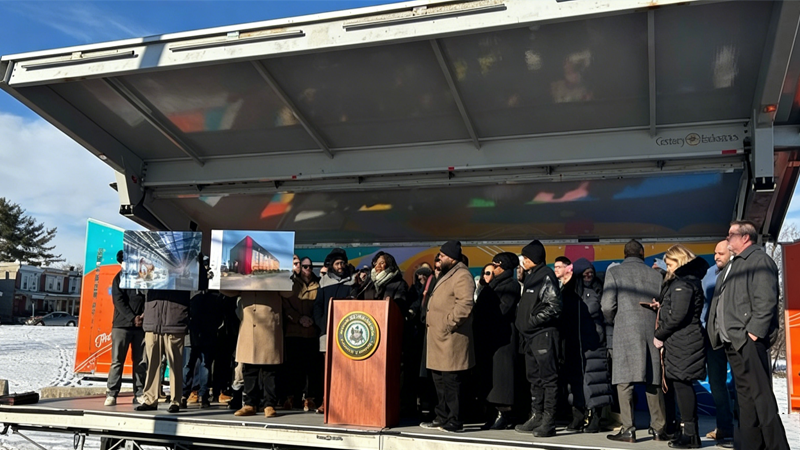 Philadelphia Mayor Cherelle Parker presents her latest affordable housing plan
Looking ahead, the role of modular housing is undergoing a fundamental transformation: it is no longer just an emergency option to address homelessness, but is becoming the core backbone of the housing system in the U.S. and globally. It proves that the industrialized path can not only solve the bottom-line issue of "adequate housing for all", but also simultaneously achieve industrial upgrading, employment security and urban revitalization, promoting the coordinated development of the entire industrial chain covering modular housing, commercial modular buildings and factory-built housing.
When factory assembly lines continuously produce safe, affordable and dignified homes, and construction workers can build their family futures in stable jobs, the true value of modular housing goes beyond construction itself. It is a structural transformation that balances efficiency and fairness, industry and people's livelihoods, as well as an inevitable choice of this era for residence and dignity. The golden age of modular housing has arrived.