The U.S. housing market is grappling with an unprecedented affordability crisis, characterized by a national housing shortage of 4 million units, median single-family home prices staying around $400,000, and 30-year mortgage rates remaining consistently above 6%. For investors, industry stakeholders, and policymakers seeking solutions, modular and manufactured homes—long overlooked in the traditional housing landscape—are emerging as a viable and scalable answer. Fueled by bipartisan policy support, shifting consumer preferences, and inherent inefficiencies of on-site construction, the U.S. modular housing market is poised for significant growth between 2026 and 2031. This comprehensive analysis explores the current market state, key growth drivers, pressing challenges, and long-term outlook of the U.S. modular housing industry, optimized to address the most critical questions for those tracking this evolving sector.
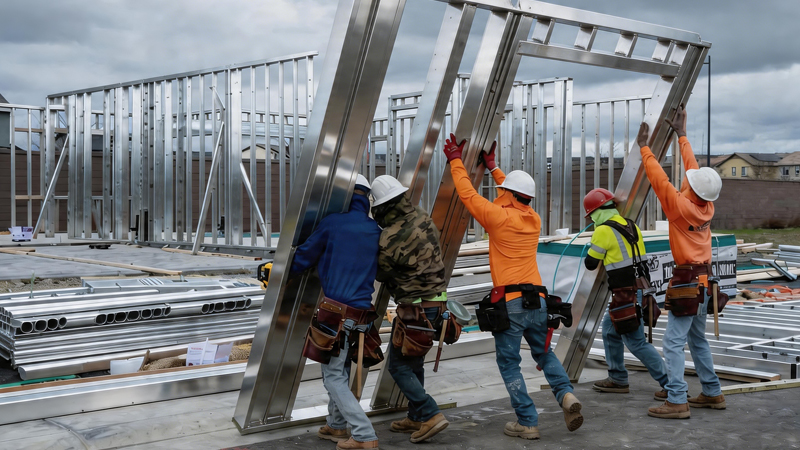 workers-assembling-modular-housing-steel-frames-us-construction-site
In March 2026, the U.S. Senate passed the 21st Century Road to Housing Act (ROAD Act) with rare bipartisan support, marking a historic turning point for the modular housing industry. This landmark legislation, which passed by a vote of 89-10, includes over 40 provisions aimed at reducing housing costs, accelerating new home construction, and addressing the national housing shortage—and modular housing stands to benefit significantly from its key reforms.
The most transformative change introduced by the ROAD Act is the elimination of the decades-old requirement that manufactured homes must be built on permanent steel chassis. For over 50 years, this mandate had pigeonholed modular and manufactured homes as "mobile homes," restricting their placement in traditional residential neighborhoods, limiting design flexibility, and reducing their market value. By allowing detachable chassis, the act not only lowers production costs by $5,000 to $10,000 per unit but also aligns modular homes with standard residential zoning regulations, removing a major barrier to mainstream adoption.
Additionally, the ROAD Act enhances financial accessibility for modular homebuyers by increasing federal loan limits for FHA and VA loans, making it easier for first-time buyers to secure financing with down payments as low as 3.5%. It also streamlines the approval process for modular home designs, cutting permitting times by more than 50% in many states, which addresses one of the biggest inefficiencies in traditional on-site construction.
Industry leaders have already responded to these policy shifts. Clayton Homes, a subsidiary of Berkshire Hathaway and the largest player in the modular housing market, is expanding its production capacity to meet growing demand. Cavco Industries, another top manufacturer, has invested heavily in upgrading its factories to produce detachable-chassis homes, noting that this flexibility will "break down zoning barriers and increase the supply of low-cost, high-quality housing." The Manufactured Housing Institute, the industry’s trade association, has called the ROAD Act a "game-changer" that will finally allow the industry to shed its "mobile home" stigma.
Beyond policy support, several market forces are driving the growth of modular housing in the U.S. The most pressing is the ongoing housing supply shortage, which the National Association of Realtors (NAR) estimates will take years to resolve with traditional construction methods alone. Modular homes offer a solution: they are built in factories in 1 to 2 months—60% to 70% faster than on-site homes—and require fewer on-site workers, addressing the industry’s critical labor shortage (currently 550,000 workers short of pre-2006 levels).
Cost efficiency is another key driver. Modular homes typically cost $80 to $160 per square foot, compared to $150 to $250 per square foot for traditional on-site construction. This price gap is particularly appealing in high-cost markets like California, Florida, and Texas, where land prices are soaring and affordability is a top concern. A recent Redfin report highlighted that modular homes could "unlock new housing supply in land-scarce areas" where traditional construction is no longer feasible.
Shifting consumer preferences are also playing a role. A 2025 survey by the Center for Generational Dynamics found that only 8% of renters in single-family homes view homeownership as the "American Dream," while 70% value the flexibility and reduced responsibility of renting. Modular homes are well-suited to this trend, as they can be quickly deployed in rental communities—filling the gap left by the Trump administration’s ban on large institutional investors purchasing single-family homes.
That ban, which prohibits institutional investors with 350 or more single-family homes from buying additional存量 properties, was intended to make homes more accessible to individual buyers. However, data from the American Enterprise Institute (AEI) shows that such investors own less than 1% of U.S. homes, and their withdrawal from the market could reduce single-family home production by nearly 40,000 units annually, according to the National Association of Home Builders (NAHB). Modular housing is emerging as a natural replacement, offering a scalable way to add both rental and for-sale housing without relying on institutional capital.
Despite the positive momentum, the U.S. modular housing industry faces several challenges that could slow its growth. The most significant is lingering consumer stigma: many Americans still associate modular homes with low quality and low value, even though modern modular homes meet the same building codes as traditional homes. This perception has led to lower resale values and resistance from some residential neighborhoods.
Regulatory fragmentation is another hurdle. While the ROAD Act sets federal guidelines, building codes and zoning regulations vary by state and local jurisdiction, creating inconsistencies that increase costs for manufacturers. For example, some states still require modular homes to meet stricter standards than on-site homes, while others have not updated their zoning laws to reflect the ROAD Act’s changes.
Supply chain and capacity constraints also pose a risk. Most modular home manufacturers are currently operating at or near full capacity, and expanding production takes 18 to 24 months. Additionally, rising material costs—driven by tariffs and global supply chain disruptions—have eroded some of the cost advantages of modular construction, though manufacturers are working to mitigate this by optimizing production processes and sourcing local materials.
There is also tension within the factory-built housing sector. The Modular Home Builders Association (MHBA) has expressed concerns that the ROAD Act’s reforms will blur the line between modular homes (which follow state and local building codes) and manufactured homes (which follow federal HUD codes). MHBA executives warn that this could confuse consumers and undermine the premium positioning of modular homes, which are often designed to be more customizable and higher-quality than traditional manufactured homes.
Despite these challenges, the long-term outlook for the U.S. modular housing market remains strong. Industry analysts project that the global modular construction market will grow at a CAGR of 6.67% through 2031, with the U.S. residential segment outpacing this rate at 6.8%. By 2031, the U.S. modular housing market is expected to reach $61 billion, up from $45 billion in 2025.
Key growth areas include rental communities, accessory dwelling units (ADUs), and rural housing. The ROAD Act’s relaxation of ADU regulations—allowing small, modular-built backyard cottages and in-law suites—has opened a new market segment, as Redfin notes that homes with ADUs are "increasingly popular" among renters and homeowners alike. In rural areas, modular homes are addressing a critical shortage of affordable housing, with the ROAD Act’s rural housing provisions expected to benefit 400,000 low-income rural residents.
Consolidation is also likely in the coming years, as large corporations like Berkshire Hathaway (via Clayton Homes) and Cavco Industries expand their market share. Smaller manufacturers may struggle to keep up with demand and regulatory changes, leading to a more concentrated industry—with the top 5 manufacturers projected to hold 60% of the market by 2031, up from 40% today.
Political uncertainty remains a wildcard. The ROAD Act must still be reconciled with the House of Representatives’ version of the bill, and President Trump has vowed not to sign any legislation until Congress passes a controversial voter ID bill. However, with the 2026 midterm elections approaching, both parties have an incentive to deliver on housing affordability—a key voter concern—making compromise likely.
The U.S. modular housing industry is at an inflection point. The ROAD Act has removed decades of regulatory barriers, market demand is growing due to the housing shortage and shifting consumer preferences, and industry leaders are investing in capacity and innovation. While challenges like consumer stigma and regulatory fragmentation remain, the long-term trend is clear: modular housing is no longer a niche alternative, but a mainstream solution to America’s housing crisis.
For investors, modular housing offers exposure to a fast-growing sector with strong policy support. For policymakers, it is a scalable way to address the housing shortage without relying on institutional capital. For consumers, it provides an affordable, high-quality alternative to traditional homes—whether they are renting or buying. As the U.S. housing market continues to evolve, modular housing will play an increasingly critical role in shaping the future of American housing.